Highlights
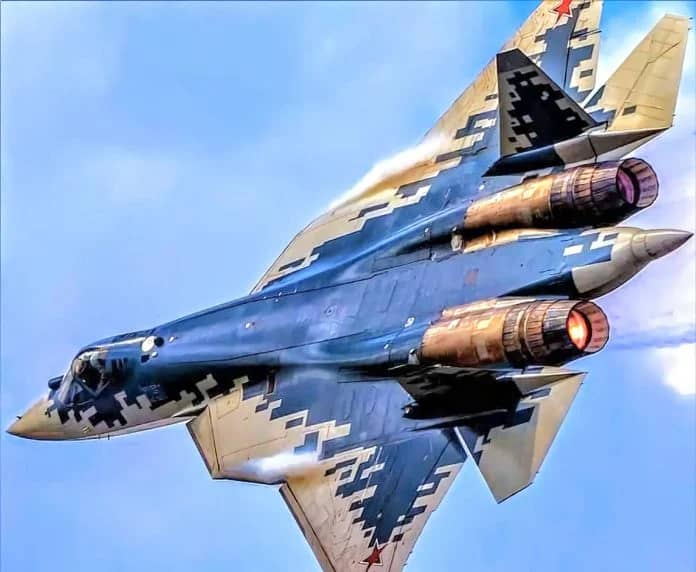
•Russia’s state-owned Rostec Corporation claims to have developed an AI-enabled communication system for its fifth-generation Su-57 stealth aircraft.
•The communication system uses cognitive radio technology, ensuring the reliability of information transmission due to noise-immune coding, interleaving of symbols in the message, and common time synchronization in signal processing.
•Russia’s sixth-generation fighter aircraft will be developed based on its Su-57 fighter jet, and hardware elements designed for the sixth-generation fighter are being tested on prototype versions of the Su-57.
Russia’s state-owned Rostec corporation has announced the successful development of an AI-enabled communication system for the fifth-generation Su-57 stealth aircraft.
The communication system was developed by the specialists of NPP Polet, a part of Ruselectronics, and uses cognitive radio technology, which enables the communication system to use the best wireless channels in its vicinity, thereby making it immune to interference.
Join our WhatsApp ChannelThe equipment also ensures the reliability of information transmission through noise-immune coding, interleaving of symbols in the message, common time synchronization, and the use of artificial intelligence technologies.
Aleksey Komyakov, General Director of NPP Polet, stated that onboard digital communication systems are widely used to transmit messages between aircraft avionics and ground services.
Virtual AI Co-Pilot For Su-57 Stealth Fighter
Russian President Vladimir Putin has been advocating the indigenous development of artificial intelligence, including AI-based technologies in its most advanced Su-57 fighter jet.
Reports suggest that the modernized version of the Su-57, called the “Su-57M”, undertook a test flight to check the working of a new AI-based system that would act as a virtual co-pilot by gathering data from the aircraft’s numerous sensors and provide crucial information to the human pilot.
The AI system would assume some of the pilot’s tasks, such as piloting and preparations for using weapons, ensuring faster decision-making for the pilots.
Artificial intelligence is poised to play an increasingly important role in the operation of modern fighter jets, thereby expanding the aircraft’s capabilities and survivability. Such AI-enabled systems will most likely find use in sixth-generation fighter jets.
Russia’s Sixth-Gen Fighter Development Program
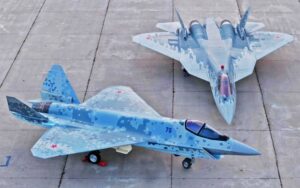
Russia’s sixth-generation aircraft will be developed based on its Su-57 fighter jet. Yuri Slyusar, the Director General of the United Aircraft Corporation (UAC), part of Russia’s state-owned defense conglomerate, stated that the fifth-generation Su-57 fighter is a step toward the sixth-generation aircraft.
The country’s Sukhoi design bureau proposed the designs for the new sixth-generation fighter aircraft in 2016, and the then Commander of the Russian Aerospace Forces announced that a sixth-generation fighter was being developed in manned and unmanned versions.
Since then, Russian defense officials have been testing hardware elements designed for the sixth-generation fighter jet on the prototype versions of the Su-57, including flight and navigation systems, advanced electronic warfare, and radar systems.
A senior official from the Concern Radio-Electronic Technologies (KRET) revealed that the sixth-generation fighters would be fitted with a unified electronic warfare system, which would serve as radar, an electronic warfare system, a data transmission system, and as communication equipment, navigation systems, and an Identification Friend or Foe (IFF) transponder. The Russian approach to the sixth-generation fighter development is similar to the one adopted by the US for its Next Generation Air Dominance (NGAD) fighter.
Conclusion
Russia’s continued focus on developing AI-enabled systems for its fighter jets and its approach to sixth-generation fighter development based on the Su-57 fighter jet is a clear indication of its commitment to enhancing its military capabilities. The use of cognitive radio technology in its AI-enabled communication system for the Su-57 is expected to improve the quality of information transfer and expand the aircraft’s capabilities and survivability.